1. Introduction : Le rôle des résines de polyamide dans les encres d'imprimerie modernes
Les résines de polyamide, en particulier celles dérivées d'acides gras polymérisés (acides dimères), sont des matières premières essentielles dans la production d'encres d'impression haute performance.
Ils sont principalement utilisés comme liants filmogènes dans les systèmes à base de solvants pour les emballages souples.
Leur principal atout réside dans leur adhérence exceptionnelle aux substrats non poreux tels que les films de polyéthylène (PE), de polypropylène (PP) et de polyester (PET) traités, combinée à une brillance et une résistance élevées.
2. Sélection de la résine : Adaptation de la chimie à l’application
Toutes les résines de polyamide ne sont pas égales.
La première étape cruciale consiste à sélectionner la qualité de résine appropriée en fonction de la méthode d'impression et des exigences d'utilisation finale.
2.1 Polyamides solubles dans l'alcool vs. polyamides co-solvants
Pour l'impression flexographique et héliogravure, les résines polyamides solubles dans l'alcool constituent la norme industrielle.
Ces résines sont des produits de condensation d'acide dimère (mélanges d'acides dibasiques C20-C44) avec des diamines telles que l'éthylènediamine et la pipérazine.
Ils sont conçus pour se dissoudre complètement dans les alcanols inférieurs (éthanol, isopropanol) sans nécessiter d'hydrocarbures aromatiques.
•Qualités à usage général : Offrent une adhérence, une brillance et une résistance au blocage équilibrées.
Idéal pour l'impression de surface sur des polyoléfines traitées.
•Qualités anti-blocage élevées : Caractéristiques points de fusion élevés (140-150°C) et résistance supérieure au collage des couches.
Convient aux applications sensibles à la chaleur.
Grades compatibles avec la nitrocellulose : nécessitent moins de nitrocellulose (NC) que les résines conventionnelles, ce qui simplifie les formulations et réduit les coûts tout en maintenant l’adhérence.
2.2 Paramètres clés de spécification
Lors de la qualification d'une résine, évaluez les propriétés typiques suivantes :
• Point de ramollissement (boule et anneau) : généralement 100-120°C.
Influe sur la résistance au blocage et la vitesse de séchage
• Indice d'acide et indice d'amine : généralement < 10 mg KOH/g. Des valeurs faibles indiquent des résines stables et non réactives.
• Viscosité (Gardner-Holdt) : varie de EH (pour les encres à haute teneur en solides) à des valeurs plus élevées.
Influe sur le transfert et le flux d'encre
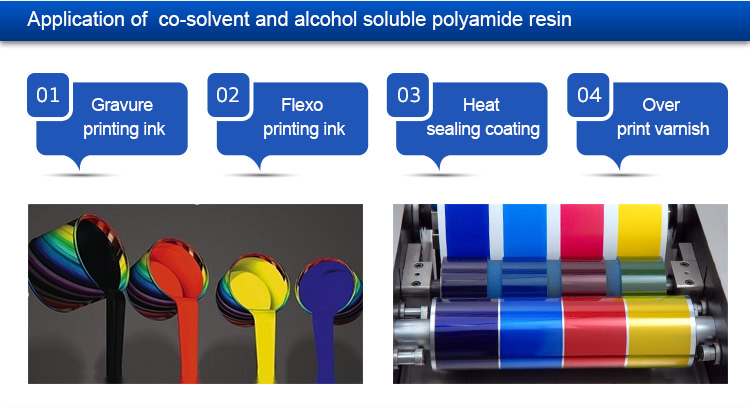
Stratégies de formulation spécifiques à l'application
Encres de plastification
Pour les emballages souples multicouches (par exemple, les emballages de snacks), l'encre doit non seulement bien s'imprimer, mais aussi accepter l'adhésif et résister à la lamination.
• Exigence : Forte résistance d'adhérence.
• Formulation : Utiliser un polyamide de masse moléculaire élevée (Mw 40 000-60 000) à base de pipérazine
Évitez un excès de cire qui peut réduire la force d'adhérence.
L'ajout de tensioactif APG est particulièrement efficace ici pour renforcer l'adhérence - Impression de surface à grande vitesse
Pour l'impression sur film PE traité destiné aux sacs.
• Exigence : Séchage rapide, faible odeur.
• Formulation : Utiliser des polyamides de faible viscosité.
Mélanger avec de la nitrocellulose pour augmenter la dureté et la vitesse.
performance de la presse à graines
Vernis de surimpression (OPV)
• Exigence : Brillance élevée, résistance au frottement.
• Formulation : Utiliser du polyamide soluble dans l'alcool comme seul agent filmogène (15-30 % de résine solide).
Ajouter des cires de polyéthylène pour faciliter le glissement.





 Réseau IPv6 pris en charge